
This post originated as a response to concerns about the appropriateness of holding an evening service of prayer the day after Election Day.
On the evening of 5 November through the morning of 6 November, I received a number of messages from members of Bethlehem Evangelical Lutheran Church expressing fear and uncertainty about the safety of either themselves or their friends and family, concerns that I shared. In response, our Precentor and I quickly put together a plan to use our regularly scheduled Wednesday night Evening Prayer slot for a service of comfort and lament, and I sent an invitation to the congregation, letting them know that, if they needed it, we would be available to sing and pray with them. That invitation read:
Last night’s events have understandably left many confused, afraid, angry, and grieved. If you’re at a loss, I invite you to come to Evening Prayer tonight at 6:30 pm. We won’t be using our usual format. Instead, our Precentor will lead us in songs of comfort and lament, allowing us to express our grief even if we don’t have our own words to do so, and to support one another. You can light a candle, or say a prayer, or get a hug, or whatever you need. (Hymn requests will be welcome!)
While we have other obligations beginning at 7:00 pm, you can stay afterward for as long as you need. You can even join us in Choir or Wednesday books if you wish. Whatever you’re feeling, you can come and be with each other as we look for ways to move forward.
Questions were raised if this kind of invitation was appropriate because the precipitating event was an election, a political event, and why no such service was held four years ago.
I first apologize for the ambiguous wording of the invitation that led to confusion. It was quickly written to get it out with enough time for people to see it and be able to respond if they wished. The wording was mine, and I take responsibility for it.
To help explain why prayers were requested, and why we put a quick service together, I invite you to read my story, and understand why I am more afraid for my safety and the safety of those I care about now than I was a week ago. I am afraid as a member of, with family and friends in, and a pastor to people in the LGBTQ+ community; I am afraid as a family member of, friend of, and pastor to non-white people; and I am afraid as a father expecting his second child this February. While others on Wednesday night expressed similar fears, I can only speak for myself.
Please understand: I’m not talking about simple political policy disagreements. I’m talking about the real experiences I and others for whom I care deeply have had in recent years that cause us to be afraid.
Back in October 2023 I wrote an article for our weekly Blaze newsletter about leaders in the church. I talked about my cousin, Ben, who is one of the very, very few people in our church to have accepted the call to serve as a missionary (and I’m so proud of Madeline, one of our BLC members, who is currently serving as a missionary in Mexico!). He was assigned to serve in Argentina and worked with a congregation’s after-school program. While there, he met and fell in love with David, and they were married during the COVID-19 pandemic. It took a long time, but eventually they got David’s paperwork approved, David came to the United States, and now Ben and David live together in Chicago.
In June of 2022, Justice Clarence Thomas of the Supreme Court of the United States, in a concurring opinion on the Dobbs v. Jackson Women’s Health Organization decision, wrote:
For that reason, in future cases, we should reconsider all of this Court’s substantive due process precedents, including Griswold, Lawrence, and Obergefell. Because any substantive due process decision is “demonstrably erroneous,” … we have a duty to “correct the error” established in those precedents.
The Obergefell decision mentioned is Obergefell v. Hodges, in which the Supreme Court of the United States held that the Fourteenth Amendment to the United States Constitution requires 1) that states license marriages between two people of the same sex, and 2) that states recognize a marriage between two people of the same sex when their marriage was lawfully licensed and performed out of state.
This decision by the Supreme Court is what allowed my cousin to marry the man that he loves. Without it, laws such as Tennessee’s 2017 House Bill 1111, which was an indirect attempt to define marriage as a union between one man and one woman, would take effect and allow Tennessee, and other states with similar persuasions, to discriminate against my cousin if, God forbid it, they were traveling through the state and had an emergency.
In Indiana, Governor-elect Mike Braun has consistently opposed same-sex marriage and as a United States Senator voted against protecting same-sex marriage at the federal level. If such a law were proposed here in Indiana, I am confident that it would pass and be signed if Obergefell v. Hodges is overturned. Indiana already has the Religious Freedom Restoration Act, which Governor-elect Braun supported, an act that even then-Mayor Greg Ballard of Indianapolis, a fellow Republican, opposed because it opened the door for more discrimination against the LGBTQ+ community.
At least the 2022 federal Respect for Marriage Act currently protects a same-sex marriage in one state being recognized in all others, but I worry about its repeal. There are already questions about its constitutionality.
I also worry about my cousin who is non-binary. Though their gender expression doesn’t usually draw much attention, they are still on the transgender spectrum, and I worry about what may happen to them if they come and visit me in Indiana. Governor-elect Braun opposes efforts to prevent discrimination on the basis of gender identity. I have consistently rejected the argument that discrimination against someone because they are transgender is a foundation of the Christian religion, and I reject attempts to justify discrimination using Christianity.
Outside of my family, I worry about how these and other policies might affect congregation members who are LGBTQ+. If you recall Justice Thomas’s comment above, another decision he names as one the court should overturn is Lawrence v. Texas, in which the Supreme Court held that laws prohibiting sex between members of the same sex were unconstitutional (the case went to the courts because two men had actually been arrested for having sex). Without the protection provided by Lawrence v. Texas, they are in danger of having their very relationships declared illegal.
The actions of the incoming Braun administration are as yet untested. While his policy positions as a senator give me insight into the policies he will implement as governor, he has never served as governor before, and the exact courses he will take are still not entirely known.
I have less reason for optimism on the federal level. There is a much greater chance that laws and policies that will harm members of the LGBTQ+ community, including my family, friends, and myself, will be implemented. The actions of President-elect Donald Trump’s first administration support this claim. In his first term, President Trump was consistently hostile to the LGBTQ+ community and removed protections for LGBTQ+ people in adoptions, healthcare, employment, and military service, in a departure from his previously stated positions. In 2016, then-candidate Trump was asked by Chris Wallace of FOX News, “Are you saying that if you become President you might try to appoint justices to overrule the decision on same-sex marriage?” His response was: “I would strongly consider that, yes.”
He appears to have done so with the appointments of Justices Brett Kavanaugh, Neil Gorsuch, and Amy Coney Barrett, all three of whom oppose protections for LGBTQ+ people and relationships, and none of whom view past legal precedents as binding, revealed in the Dobbs decision (though Barrett less so). Based on the policies of his previous administration, I have no reason to doubt that in the next one, attacks against LGBTQ+ people, relationships, and rights will continue. Though he has since attempted to take back some of his statements, actions speak louder than words, and I believe his actions over his words.
A classmate and colleague of mine, the Reverend Father Benjamin Garren, had this to say when asked why we LGBTQ+ folks were afraid:
When LGBTQ+ individuals are talking about persecution under a Trump Administration we are not expecting secret police in the night. We are expecting death by a thousand cuts. A series of laws, ordinances, and court decisions where any one by itself can be readily dismissed as inconsequential by someone whose homophobia and transphobia is only passive in nature. The plan is not for all of us to disappear in a year or two but to create a society where a generation from now the LGBTQ+ community has slowly been suppressed back into the closet. Every little nick of an ordinance, piece of legislation, or court ruling matters in this scenario.
It is not just policies affecting LGBTQ+ people that have me worried. Incoming administrations have a disturbing relationship with racism and white supremacy.
During his first administration, President Trump ordered federal agencies to stop anti-racism trainings. When a self-identified white supremacist, James Fields Jr., rammed his car through a crowd of counter-protestors at the 2017 Unite the Right neo-Nazi, KKK, white supremacist rally in Charlottesville, Virginia, killing Heather Heyer and injuring more than thirty others, President Trump attempted to blame both the counter-protesters and the neo-Nazis for the event. When pressured, he modified his statement to condemn white supremacy, but the next day returned to spreading the blame to those who oppose racism.
His views on race are well documented, from his illegal housing discrimination against African-American tenants in the 1970s, to his false claims about Native American ethnicity and color in the 1990s, to criticizing a judge’s ability to adjudicate cases because of his Mexican heritage in the 2010s, to claiming that he had seen Arab Americans cheering when the World Trade Center was attacked, to platforming white genocide conspiracy theorists on Twitter/X, to his condemnation of the Central Park Five who were falsely accused in 1989 of attacking and raping a jogger in Manhattan’s Central Park.
The last case deserves special mention. When the Central Park Five were definitively exonerated by DNA and a confession from the actual attacker in 2002, and their sentences were vacated, Trump continued to assert their guilt. He repeated this statement during his presidential campaign in 2016, which caused Republican Senator John McCain to retract his endorsement of Trump out of disgust. Even as recently as two months ago, September 2024, candidate Trump continued to maintain that the Central Park Five were guilty. This unwillingness to reform, to continue demonizing and attacking innocent black men, disturbs me.
Like many others, I was disturbed that so many white supremacist organizations and people supported candidate Trump’s first presidential campaign. I do not believe one must necessarily be judged by who claims to endorse someone, but the fact that white supremacists saw hope for their movement in Trump’s platform, combined with his decades of racist behavior, give me pause.
These patterns of behavior make me afraid for what may be coming for my brother-in-law, a black man, who still experiences racism in his job in, of all things, tech support (apparently, people care if their tech is white or black); and for the people of color in our congregation, some of whom remained resilient when racism split the congregation back in the 1950s (the admission of the first black member to the congregation created a wave of backlash), and are seeing a resurgence of ideologies they’ve worked their whole lives to fight. There has been a dramatic rise in white nationalist activity in the United States in recent years, and it’s about something we all, white people included, should be concerned.
Lastly, I want to share my fears about my child’s birth coming in February.
My wife is considered to be of “advanced maternal age”, what they used to call “geriatric pregnancy” (what a name, right?). These pregnancies carry additional risks of preeclampsia, birth defects, miscarriage, pre-term birth, stillbirth, fetal death, and the need for Caesarean delivery. So far, her pregnancy has been healthy, for which I thank God. But the risks of something happening are there. I try my best not to worry about them, but it’s easier some days than other.
If, God forbid, something were to happen during pregnancy or delivery, I need to be absolutely certain that she will be able to receive the healthcare she needs.
Before our child was born, she suffered a miscarriage, about which we’ve been frank and public. We found out when an ultrasound revealed a lack of fetal heartbeat. It was devastating. Unfortunately, she required a dilation and curettage (D&C) procedure. Without the procedure, she was at risk of developing sepsis, which can be fatal. But, she was able to have the procedure done. A year later, our child was born.
After the Supreme Court’s decision in Roe v. Wade was overturned, Indiana passed 2022 Senate Bill 1, which completely bans abortions in the state at any point in the pregnancy except in cases of fatal fetal abnormality, to preserve the life of the mother, or in cases of rape or incest.
The procedure my wife endured is an abortion. In her case, there was no fetal heartbeat, and Roe v. Wade was still settled precedent. Her hospital had no issue performing the D&C.
Other states have passed laws similar to Indiana’s own. Abortions are illegal except in circumstances similar to what is stated above. While that is reason enough for concern, what terrifies me is their implementation.
So far in Texas, two women suffering miscarriages have died because Texas law forbids doctors from treating them if there is still a fetal heartbeat. It enacts extremely harsh penalties, fines, and prison time for doctors who treat women in the midst of a miscarriage. The law technically says that an abortion can be performed if there is an imminent threat to the life of the mother, but the law is worded in such a way that doctors and hospitals fear prosecution. Neither woman in Texas wanted an abortion. They wanted their babies. But because of Texas’s anti-abortion law, they are now dead.
Similar cases have happened in Georgia.
When Roe v. Wade was overturned, we were assured that abortion issues would be left to the states. This is what has happened since then. Women are dying because they cannot get the healthcare they need. I understand the desire to limit abortions to certain cases. In fact, the exceptions mentioned actually align with the ELCA’s social statement on abortion. Almost no one publicly says a woman who has a miscarriage and needs an abortion to save her life should be denied one. Yet, that’s exactly what is happening, and the legislators who passed these laws have indicated they have no intention of changing them to account for the fact that women are dying.
That terrifies me.
If something were to happen during my wife’s pregnancy, or to her, and she could not get the healthcare she needed, like the women in the articles I linked above could not, I don’t know what I’d do. I don’t even want to think about it. But what is happening in Texas and Georgia can happen here in Indiana.
And so I’m afraid. I was up all night Tuesday night trying not to think about if something went wrong in February, because I don’t expect Indiana to reevaluate its abortion laws between now and then. It would be bad enough if something went wrong, and we all made it through. To imagine the worst… it’s crippling. I want my wife, and my child, to be safe and healthy; and if that isn’t possible, I want her to have the best possible chance at survival.
If you’ve made it this far, thank you. I mean it. Not everyone is willing to listen when people in pain want to share their stories.
I want to take up the two other points: why there was no such prayer service four years ago when President Joe Biden was elected, and whether it is appropriate in my role as Pastor of a congregation to lead such a service.
To answer the first question: no one asked for one. No one in November 2020 expressed to me fear that their lives, or the lives of people they cared about, were now in danger. I would even say the same in 2016. I was disappointed, but I didn’t feel like I was in any danger. This year, given the history I explained above, a number of people in our congregation asked for prayers and support for themselves and those they loved. Staff and I decided to respond to those requests.
To answer the second question: Christian ministry sits at many intersections. The intersection of Christian religion and civil religion is one of the more confounding ones. I have at times been accused of being too political in preaching when I call out certain societal sins; and then, without a hint of irony, I’ve been accused of not being political enough, by not emphasizing Memorial Day enough in worship (I kid you not, I once had an angry parishioner at the parsonage door because they didn’t see me at a town Memorial Day commemoration–that I was actually at, they just didn’t see me there!), or not asking veterans to stand and be recognized on the Sunday closest to Veterans Day, or not bringing the American flag into the sanctuary on Independence Day. I was once surprised by a guest organist who played the Star Spangled Banner as a prelude in worship and folks happily stood and sang along. It used to be common practice in congregations to pray for the country’s president and the state’s governor by name every Sunday.
We are both baptized Christians and citizens of our nation, and we who are called to be leaders have responsibilities to both. The Reverend Dr. Martin Luther King, Jr. was unashamedly political in his nonviolent resistance to racial injustice and was active in both the preaching and political spheres. The Reverend Dietrich Bonhoeffer publicly spoke against the Nazi regime in his home country, joined the Confessing Church, and participated in conspiracies to assassinate Adolf Hitler. The great saint Ambrose of Milan, upon hearing that Emperor Theodosius I permitted a massacre in Thessalonica, wrote him a letter in which he urged the Emperor to publicly repent, and would not give the Emperor the Holy Communion until he did so; the Emperor complied, and it took until Christmas for Ambrose to welcome him back to the Eucharist.
Outside of the political sphere, the church still celebrates and mourns at the intersections of daily life. It is not uncommon for churches to hold prayer vigils when someone in the community is killed. One of my great joys is getting to meet new babies that are born and bless them. The very act of a Christian funeral provides comfort and support to those who are grieving the loss of a loved one. I have blessed bicycles before community rides and helped families bury pets. I have spoken on a panel on opioid use in a rural community and helped a food pantry reform in a new location. Our building at Bethlehem hosts Al-Anon groups and spiritual direction meetings, music groups and breast-feeding support groups. And all of it is ministry.
One of my more solemn and sacred duties as a pastor is to accompany those who are hurting. It is not a duty without struggle, as the sharing of pain is sometimes confidential. I have listened to people’s confessions and assured them of God’s forgiveness. I have listened while they railed at God for letting something happen to them. I have had to tell people that I have no easy explanations for why they are suffering. It’s never easy to sit with someone else in pain.
It is that duty I exercised on Wednesday night. The songs we sang and the prayers we said were responses to real people in the congregation experiencing real fear and doubt, who asked their pastor for real reassurance that they would be alright. I would do the same for anyone in the congregation, regardless of political affiliation, personal relationship, or our level of agreement on policy.
If I am not able to offer members of our community that when they come to me–no matter what it is that troubles them, or if I agree with them or not–then I have failed as a pastor. I know I failed to adequately express what Wednesday night’s service was about. I ask your forgiveness, and commit to better communication next time the community requests prayers.
Peace,
Pastor Ken ⳨
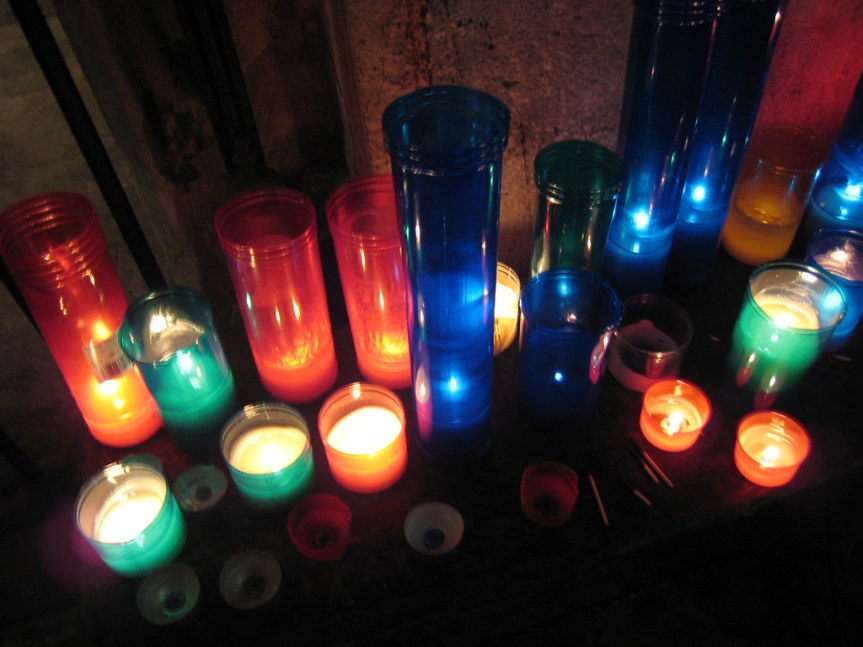
Featured Image: “Prayer Candles at a Cathedral in Barcelona” by David Wiley is licensed under CC BY 2.0.

 Living an Ecumenical Life
It’s a powerful reminder of the importance of community, faith, and the shared strength that prayer brings. Your words inspire and encourage deeper reflection on the bonds that unite us through spiritual practice.
LikeLike