
Happy Easter! Today we celebrate the Resurrection of Our Lord, Easter Sunday, the…
… wait, what? What do mean “It’s not Easter”? Yesterday was the first full moon after the spring equinox (20 March), today is the first Sunday after that. That means today should be Easter!
Except it’s not.
But why not?
The common way of describing the date of Easter is “the first Sunday after the first full moon after the spring equinox.” It’s simple and relatively easy to understand. Much of the time, this short formula is sufficient to calculate the date of Easter in a given year.
Unfortunately, it’s also incorrect.
Fixed and Movable Festivals
There are two kinds of festivals in the liturgical year: fixed festivals and moveable festivals. Fixed festivals always fall on the same calendar date no matter what day of the week that is. The Nativity of Our Lord (Christmas Day) always falls on 25 December. Holy Cross Day is always on 14 September. Mary Magdalene, Apostle, is always on 22 July. And so on. Most of the church’s lesser festivals are fixed festivals.
Moveable festivals, on the other hand, are tied to a certain day of the week at a certain time of year–almost always Sunday. This means they fall on different dates of the year. The Sundays of Advent are examples of moveable festivals. Because they are the four Sundays preceding the Nativity of Our Lord (25 December), the calendar dates of those Sundays change each year. Most of the church’s principal festivals are moveable festivals.
The primary moveable festival, however, is the Resurrection of Our Lord (Easter). In fact, the dates of every other moveable festival in the church, except for the Sundays of Advent, depend on the date of Easter. The Resurrection of Our Lord is the hinge around which the entire liturgical calendar swings.
When to Celebrate the Resurrection of Our Lord
According to the Biblical accounts in the Gospels, Jesus was crucified before dusk on a Friday, either the day before or the day of the Jewish festival of Passover (14 Nisan in the Jewish calendar), probably in either the year 30 or 33 CE. “On the third day” he was resurrected back to life; and since ancient Jewish custom counted days inclusively, Friday would be the first day, Saturday the second day, and Sunday the third day, the “first day of the week”. This is why Christians gather on Sunday to worship, and every Sunday is itself a celebration of the resurrection.
We don’t know exactly when a separate annual celebration of the Resurrection of Our Lord started, except that it was before the mid-second century CE. We do know that the Church didn’t celebrate it on the same day everywhere. Some celebrated it on Passover, 14 Nisan every year, no matter what day of the week that was–it was a fixed festival. Others waited until the Sunday following Passover–for them, it was a moveable festival. This was the first of the (sadly, many) “Easter controversies” and caused quite a ruckus. Each claimed to be using the “true” way of calculating the date of Easter. Both, however, calculated their celebration of the Resurrection of Our Lord based on the Jewish festival of Passover.
By the third century CE, partly because of dissatisfaction with calculating this principal festival of the Church using a Jewish festival as the starting point, and partly because the churches wouldn’t stop trying to excommunicate each other over it, the first ecumenical council (a council representing the whole Church), held in the city of Nicaea in 325 CE, decided to set two rules for calculating the date of Easter: 1) the calculation must be independent of the Jewish calendar, and 2) the whole Church needs to celebrate it on the same day.
It took awhile, but eventually the churches came around to the idea.
All that remained was to decide how the calculation would be done. And for that, we need to talk about calendars.
Calendars and Astronomical Events
We take it for granted that calendars are available right at our fingertips. We know that there are twelve months in a year, we know how many days are in each month. We know when to add leap days (more on that in a bit), and on a computer we can almost instantly look up any day in any year for millennia in either direction, past and present. Today is 13 April 2025 because that’s what the calendar says it is. I know when it will be tomorrow, 14 April, because any of the clocks in my house tell me when the time changes from 11:59 p.m. to 12:00 a.m., meaning a new day has started. And our modern calendar, with the exception of leap years, does not change.
Tracking time like this has not always been so easy. It’s actually been quite difficult for the vast majority of human history. Thankfully, there are two great big glow-y things in the sky that appear and disappear with extreme regularity: the Sun and the Moon. Ancient peoples watched these two celestial objects and used them to define our most basic calendar units: a day, the time it takes the sun to rise, set, and rise again; a month, the time it takes the Moon to go through a full cycle of its phases; and a year, the time it takes the sun to return to the same position in the sky.
Roughly. We’re spitballing here.
For most of human history, observing these astronomical events sufficed. And they were observations. One knew when the Sun rose because they could see it. One watched the Moon go through its phases. It took some doing, but one could measure the position of the Sun in the sky, record it, and see it move through and return to the same position in the sky. The calculations weren’t exact, but they didn’t need to be–mostly. The calendar was born.
It didn’t take long for humans to notice inconsistencies. Not all days were exactly the same length. The Moon took almost exactly thirty days to complete its cycle, but not quite–it was a little quicker. The Sun, on the other hand, took almost exactly 365 days to complete it’s cycle, but not quite–it was a little slower. And, the Moon completed twelve whole cycles every year, but again, it’s a little quicker–there is always time left over before the end of the year.
Trying to line up days, months, and years into neat and tidy, orderly cycles proved a challenge, and cultures all around the world came up with different solutions. It was easiest to start with the lunar month and work from there. Some decided to base their calendar entirely on the lunar cycle and ignored the solar year. Some tried to reconcile the differences between the lunar cycles and the solar year by adding extra days between months or at the end of the year, or adding an extra month every few years, becoming lunisolar calendars.
The Ancient Jewish Calendar
The Jewish people used one such lunisolar calendar. Without getting into too many details, the year was divided into twelve lunar months of twenty-nine or thirty days each, with an intercalary thirteenth month added every few years to re-sync the lunar calendar with the solar year. Each month began with the new moon, when the Moon is not visible in the sky; and the year (for festival purposes) began on the new moon that began the month of Nisan, the first month of spring.
How did one know if the month had twenty-nine or thirty days? By watching the moon. Sometimes it took an extra day to go through its full cycle, and one didn’t always know going into the month whether the Moon was going to take that time. That’s why it was important to observe the Moon in order to accurately calculate the month. The festival of Passover was to take place on 14/15 Nisan (so during the full moon, when the entire Moon is visible in sky), after the spring equinox, and one couldn’t know when that was unless one actually saw the new moon and the full moon. One could guess, but for such an important event, observation was necessary to confirm the dates. If it was cloudy on the night of the full moon or new moon, one couldn’t be really sure until the following night when the Moon could be observed.
Today the Jewish calendar, like most modern calendars, is calculated mathematically, so direct observation is no longer necessary. But the uncertainty of the observations in ancient times was one of the reasons early Christians grew dissatisfied with calculating the date of Easter from Passover (Christians were also upset that, occasionally, the Jewish calendar set 14 Nisan before the spring equinox, which they felt shouldn’t happen).
Calculating Easter: Computus
The First Council of Nicaea (325) declared that the date of the annual celebration of the Resurrection of Our Lord should be calculated independently of the Jewish festival of Passover, and that all the churches should celebrate it on the same day. It was widely agreed that the celebration should still take place in roughly the same time of the year it already did: after the spring equinox, near the next full moon. Since the council didn’t specify how the calculation should be done, various proposals were made over the next few centuries.
Noting that the lunar cycles, while not synchronized with the solar year every year, did eventually synchronize over time (in the same way that multiples of 3s and 4s synchronize at 12), various mathematical tables based on cycles of different lengths were created. Abandoning direct observation and relying on math alone allowed the church to calculate the date of Easter years in advance. The early tables weren’t perfect and were frequently adjusted, but they laid the groundwork for more intricate, and accurate, tables. This whole process came to be known as computus paschalis (“Easter computation”), or simply computus.
The table that came to be used across the Church by the eighth century CE, devised first by Dionysius Exiguus (the same guy who calculated the birth of Jesus and therefore created anno Domini, or AD–though he was off by a few years) and then modified and extended by Bede the Venerable, used a nineteen-year repeating cycle of twelve or thirteen ecclesiastical lunar months (235 months total) of twenty-nine or thirty days each, plus some extra days called epacts, named the metonic cycle. Each time through this cycle, the phases of the Moon recur at roughly the same time of year. This meant that the date of Easter could now be calculated entirely mathematically and occur around the same time of year, all without having to directly observe the Moon.
What these charts didn’t predict, however, was the exact moment of the spring equinox each year. So the Church invented one: the ecclesiastical equinox. Stay with me here.
Astronomically, the spring equinox in the Northern Hemisphere can occur on 19, 20, or 21 March. Rather than relying on such uncertainty, the Church decided that 21 March on the solar calendar would be the “spring equinox” for the purpose of calculating the date of Easter, whether or not it was actually the astronomical equinox. Math over eyeballing it. It shouldn’t be a surprise then that the creation of the ecclesiastical equinox also led to the creation of the ecclesiastical full moon. Just as the ecclesiastical equinox is always 21 March on the solar calendar, the ecclesiastical full moon is always the fourteenth day of the ecclesiastical lunar month. And the paschal full moon is the ecclesiastical full moon after the ecclesiastical equinox.
When we say that Easter falls on the first Sunday after the first full moon after the spring equinox, we mean these ecclesiastical full moon and equinox, not the astronomical ones.
All we have to do is translate the ecclesiastical full moon–the fourteenth day of the ecclesiastical lunar month after 21 March on the solar calendar–to our modern calendar date, find the next Sunday, and we have the date of Easter!
Except… we can’t all agree on what day 21 March is.
Oh God help us… it’s time to talk about calendars again.
The Roman (Julian) Calendar
In 45 BCE, Julius Caesar reformed the Roman Calendar which, while resembling the calendar we use, had some serious deficiencies; it was only 355 days long, requiring some interesting intercalary sorcery involving shortening February by five days and adding an entire extra month before March every other year, among other things. Unhappy with this arrangement, Caesar modified the Roman calendar into what we now call the Julian Calendar. The year consisted of twelve months of alternating thirty-one or thirty days (except for February, with twenty-eight days) for a total of 365 days. Every fourth year, February gained an extra day, which kept the calendar aligned with the solar year, which is 365.25 days long.
Except… well, it’s not.
Because the solar year is not exactly 365.25 days, the Julian calendar drifts. Not very much, but the Julian calendar was a massive and popular improvement over the previous calendar, and the drift was an acceptable side effect. It would be the calendar that dominated Christendom for 1600 years.
The Roman (Gregorian) Calendar
Eventually, the Julian calendar had drifted so much that the ecclesiastical spring equinox was drifting further and further away from the observed, astronomical equinox. Now able to more precisely calculate the actual length of the solar year–365.2422 days (yes, the decimal points really matter!)–scientists and the Church set out to reform the calendar to first correct the drift, and then prevent it from happening again.
The result is the Gregorian calendar, which we still use today: twelve months of thirty or thirty-one days (except poor February), with an extra day added to February every four years, except in years divisible by 100, unless that year is also divisible by 400. It was officially instituted in Roman Catholic countries in 1582 by a decree from Pope Gregory XIII (hence the name), and gradually spread across all Christian lands. On the day the Gregorian calendar was decreed, the calendar date jumped from 4 October 1582 to 15 October 1582 to immediately correct the eleven-day drift of the Julian calendar.
Because astronomical events can vary in their timing, there is still a slight drift in the Gregorian calendar. But while the Julian calendar drifts one day every 129 years, the Gregorian calendar drifts one day every 7700 years, a vast improvement.
The Gregorian calendar reform also made another change: it corrected errors in the metonic cycle used to calculate the date of Easter.
Two Easters?
Most of the world has since adopted the Gregorian calendar for civil use. It’s simply easier to work together when we all use the same dates.
But some groups still use other calendars for various purposes, including religious ones. Jewish holy days are based on the Hebrew, not Gregorian calendar. Muslim holy days are based on the Muslim calendar. Some Chinese cultural practices are based on the traditional Chinese calendar.
And some churches–the Eastern and Oriental Orthodox churches–still use the Julian calendar to calculate Easter and all other holy days. That means we don’t use the same 21 March in our calculations. 21 March is currently thirteen days different between the Julian and Gregorian calendars. Why didn’t these churches adopt the Gregorian calendar?
There’s a long history of animosity between the two great arms of the Church, East and West. When Pope Gregory XIII introduced the calendar reform and promulgated it throughout Catholic Europe, many in the Eastern churches saw the move as a unilateral attempt to impose Roman customs on the rest of the Christian world, and as a breach of the unity declared by the Council of Nicaea. In such a polarized era, the Eastern churches rejected the Gregorian calendar. Even when the churches did finally adopt it for civil use centuries later, they retained the Julian calendar for religious holy days.
As of 2025, the Julian and Gregorian calendars are thirteen days out of sync, and that gap will continue to widen. Because Western churches calculate Easter using the Gregorian calendar and corrected metonic tables, and Eastern churches calculate Easter using the Julian calendar and uncorrected metonic tables, each calculates a different date for Easter.
Usually. Because sometimes, things land just right, the computations match, and the whole Church celebrates the Resurrection of Our Lord – Easter Day on the same day. Like in 2025.
One Date for Easter?
The complicated computus system was invented because using intricate mathematics seemed to be the only way the Church could calculate a date for Easter years in advance that satisfied the desire to celebrate it on the Sunday after the full moon after the spring equinox, without having to directly (and sometimes inaccurately) observe the astronomical events. Today, our technology is far better at both observing and calculating in advance these and many other astronomical events to a much greater degree of accuracy than the early Church leaders could possibly imagine. Computus as it exists is no longer strictly needed.
So why do we still rely on this archaic, complicated method of calculating the date of Easter, using two different calendar systems that don’t align? The answer, and I’m not joking, is quite literally, “This is the way we’ve always done it.”
Maybe one day, the whole church will annually celebrate the Resurrection of Our Lord together, just as the Council of Nicaea intended. The current division isn’t sustainable. Adherents of the Julian calendar know that the calendar’s drift will only get worse, and eventually something will have to be done (in fact, there is a proposed Revised Julian Calendar adopted by some Eastern churches that not only synchronizes the old Julian and the Gregorian calendars, but is actually slightly more accurate than the current Gregorian calendar in the far future). Adherents of the Gregorian calendar are looking for simpler ways to calculate the date of Easter that doesn’t involve complicated tables, ecclesiastical equinoxes, and ecclesiastical full moons.
There have been a number of proposals to unify the Church’s calculations. One is to celebrate Easter on a fixed Sunday every year, say, the second Sunday in April. Another is to celebrate it on a Sunday that falls within a certain date range. Another is to keep the same basic scheme–the first Sunday after the first full moon after the spring equinox–but to calculate it astronomically, with the meridian at Jerusalem. So far, while there has been growing support for a unified celebration of the Resurrection of Our Lord, no single proposal has gained enough traction to overcome the centuries of tradition behind computus.
So Why Is Today Not Easter Day?
And now, finally, we return to the reason I researched and wrote all of this down. Yesterday, 12 April, was the full moon. So why isn’t today, 13 April, the first Sunday after the full moon after the spring equinox, the Resurrection of Our Lord? The answer is the difference between the locally observed full moon and the ecclesiastical full moon. For the following, ignore the reality that the two branches of the Church use two different solar calendars with two different 21 Marches; we’re going to focus solely on the Western church and the Gregorian calendar.
When the astronomical full moon occurs on Monday-Friday, it’s pretty easy to figure out when the following Sunday is. When it falls on Saturday or Sunday, however, things get interesting. Depending on where in the world you are, your time zone, and when exactly the astronomical full moon occurs, the full moon could be on Saturday or Sunday. That’s what happened this year.
In North America, the astronomical full moon occurred on Saturday, 12 April 2025 around 8:30 PM EDT. But in, say, Rome, a full six hours ahead of EDT, the astronomical full moon occurred on Sunday, 13 April 2025 around 2:30 AM. If the date of Easter was calculated based on the locally observed astronomical full moon, half the Western churches would celebrate Easter on 13 April, and half on 20 April, one week later.
But Easter is calculated based on the ecclesiastical full moon, which according to the computus falls this year today, Sunday, 13 April. And because the Resurrection of Our Lord is celebrated on the first Sunday after the ecclesiastical full moon, it has to move to the following Sunday: 20 April 2025.
And there you have it.
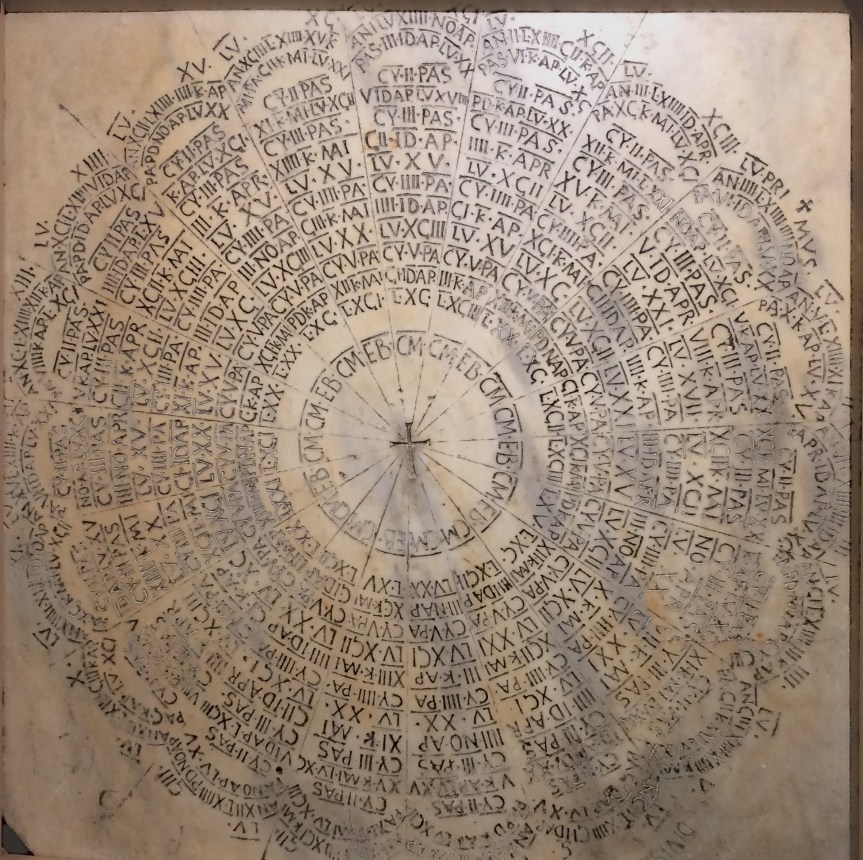
Featured Image: “Easter Calendar for AD 532-626” by Apatak is licensed under CC BY-SA 4.0

 Living an Ecumenical Life